When shopping for lumber, one of the first decisions you may encounter is whether to choose hardwood or softwood.
Although their names suggest that one type is harder than the other, the distinction is actually based on botanical classification rather than physical hardness.
Hardwoods come from flowering plants known as angiosperms, while commercial softwoods primarily come from coniferous trees belonging to a group of plants known as gymnosperms.
Both categories include wood species with different densities, colors, grain patterns, durability characteristics, and woodworking applications.
Understanding these differences can help you select the right material for furniture, cabinetry, live edge tables, decorative projects, and other woodworking applications. You can also browse our for examples of available wood.
What Is Hardwood?
Hardwood lumber comes from angiosperm trees.
Many familiar hardwood species have broad leaves and lose their foliage seasonally. However, some hardwood trees, particularly tropical species, remain evergreen.
Hardwoods are commonly used for furniture, cabinetry, flooring, decorative woodworking, and specialty projects.
Popular examples include:
- Walnut
- White oak
- Red oak
- Maple
- Cherry
- Ash
- Mahogany
- Sapele
- Purpleheart
- Padauk
- Teak
- Hickory
Hardwood species vary considerably in appearance, density, workability, and natural resistance to environmental conditions.
Some are particularly suitable for demanding furniture applications, while others are valued primarily for their distinctive color or grain.
What Is Softwood?
Commercial softwood lumber primarily comes from coniferous trees.
Many of these trees have needle-like or scale-like foliage and produce cones.
Common softwood species include:
- Pine
- Cedar
- Douglas fir
- Spruce
- Redwood
- Hemlock
- Cypress
Softwoods are widely used in residential construction, framing, shelving, outdoor structures, furniture, and general woodworking.
Many softwoods are relatively easy to cut and shape, making them popular for certain beginner woodworking projects.
However, their properties vary considerably between species.
Some softwoods are naturally durable in appropriate outdoor applications, while others require additional protection from moisture and biological deterioration.
Hardwood vs. Softwood: Key Differences
| Characteristic | Hardwood | Softwood |
|---|---|---|
| Botanical classification | Angiosperms | Primarily coniferous gymnosperms |
| Common leaf type | Broad leaves | Needles or scales |
| Wood anatomy | Most commercial species contain vessels | Primarily tracheids |
| Physical hardness | Varies by species | Varies by species |
| Growth rate | Often slower, with exceptions | Often faster, with exceptions |
| Appearance | Wide variety of colors and grain patterns | Often lighter colors, with notable exceptions |
| Common applications | Furniture, cabinetry, flooring, specialty woodworking | Framing, construction, furniture, outdoor projects |
| Cost | Often higher for furniture-grade and specialty lumber | Often lower for commonly available construction lumber |
| Natural durability | Depends on species and heartwood characteristics | Depends on species and heartwood characteristics |
Neither category is automatically superior.
The best choice depends on the specific wood species and the requirements of your project.
Is Hardwood Always Harder Than Softwood?
No. This is one of the most common misconceptions about lumber.
The terms hardwood and softwood describe botanical categories rather than measurable physical hardness.
For example, balsa is classified as a hardwood despite being exceptionally lightweight and soft.
Certain softwoods, including some Southern yellow pine species, can be harder than several commonly used hardwoods.
When hardness matters, woodworkers should evaluate the properties of the individual species instead of relying solely on its classification.
What Is the Janka Hardness Scale?
The Janka hardness test measures a wood sample’s resistance to indentation.
It determines the force required to embed a standardized steel ball halfway into the wood.
Janka hardness ratings are useful when comparing materials for applications where resistance to dents and surface wear is important.
Examples include flooring, tabletops, work surfaces, and furniture.
Here are approximate Janka hardness values for several familiar wood species.
| Wood Species | Classification | Approximate Janka Hardness |
|---|---|---|
| Eastern white pine | Softwood | 380 lbf |
| Black cherry | Hardwood | 950 lbf |
| Black walnut | Hardwood | 1,010 lbf |
| Northern red oak | Hardwood | 1,290 lbf |
| White oak | Hardwood | 1,360 lbf |
| Hard maple | Hardwood | 1,450 lbf |
| Purpleheart | Hardwood | 2,520 lbf |
These values are representative rather than guaranteed measurements for every individual board.
Wood properties can vary according to growing conditions, moisture content, grain orientation, and the specific species.
Hardness is also different from bending strength, stiffness, toughness, and natural decay resistance.
A high Janka rating does not automatically make a wood species suitable for every project.
Why Do Hardwood and Softwood Have Different Grain Patterns?
The internal structure of wood influences its appearance and working characteristics.
Most commercial hardwood species contain vessels that transport water through the tree.
When lumber is cut, these vessels can contribute to visible pores and distinctive grain patterns.
Oak, for example, typically has a more prominent pore structure than hard maple.
Softwoods primarily rely on elongated cells called tracheids for water transport and structural support.
Their appearance may be strongly influenced by differences between earlywood and latewood growth.
Grain appearance also depends on:
- Wood species
- Growth conditions
- Sawing method
- Grain orientation
- Knots
- Natural figure
- Heartwood and sapwood
- Surface preparation
- Applied finish
Woodworkers interested in decorative projects should examine individual boards rather than select lumber based only on species names.
What Are the Benefits of Hardwood?
Hardwood offers several advantages for furniture making and specialty woodworking.
Wide Variety of Colors
Hardwood species provide an extensive range of natural colors. Walnut is valued for its rich brown tones, maple for its lighter appearance, and purpleheart for its distinctive purple coloration. Cherry, padauk, sapele, and other species offer additional design possibilities.
Natural wood colors may change over time due to light exposure, oxidation, and finishing products.
Distinctive Grain Patterns
Hardwoods can feature straight grain, interlocked grain, curls, burls, and other visually interesting characteristics.
These features make certain hardwood boards and slabs particularly attractive for statement furniture and decorative projects.
Resistance to Surface Wear
Many hardwood species provide good resistance to dents and everyday wear. This can be beneficial for dining tables, cabinetry, desks, and other frequently used surfaces.
However, resistance varies significantly by species.
Furniture and Cabinetry Applications
Hardwood is widely used for furniture because suitable species offer desirable combinations of appearance, strength, stability, and finishing characteristics.
Selecting properly dried lumber and using appropriate construction techniques remain essential.
Specialty Woodworking Opportunities
Exotic and figured hardwoods are frequently selected for:
- Live edge furniture
- Woodturning
- Decorative inlays
- Jewelry boxes
- Custom cabinetry
- Artistic woodworking
- Specialty gifts
Individual boards can provide unique visual characteristics that make each finished project different.
What Are the Benefits of Softwood?
Softwood also offers important advantages.
Affordability
Common construction-grade softwoods are often more affordable than furniture-grade hardwoods or imported exotic lumber.
This can make them suitable for larger projects or applications where decorative hardwood is unnecessary.
Workability
Many softwoods are relatively easy to cut, shape, drill, and fasten.
This can be helpful for beginner woodworking and general construction projects.
However, knots, resin, grain characteristics, and differences between earlywood and latewood can influence machining and finishing.
Availability
Pine, spruce, and other commonly used softwoods are widely available in many standard construction dimensions.
Lower Weight
Many softwood species are relatively lightweight compared with denser hardwoods.
This can be beneficial for certain furniture, shelving, and construction applications.
Outdoor Applications
Some softwoods, including the heartwood of certain cedar, cypress, and redwood species, offer useful natural decay resistance.
Appropriate species selection, construction design, and maintenance are still necessary for outdoor performance.
Hardwood vs. Softwood: Which Lasts Longer?
The lifespan of a wood product depends on more than its botanical classification.
Important factors include:
- Natural decay resistance
- Resistance to insects
- Moisture exposure
- Wood density
- Quality of construction
- Environmental conditions
- Applied finish
- Maintenance practices
Some hardwood species perform well in demanding environments, while others deteriorate when exposed to persistent moisture.
Certain softwood species can also provide excellent outdoor performance when their properties match the intended application.
For outdoor projects, natural durability and moisture management may be more important than surface hardness.
For indoor furniture, stability, construction quality, and resistance to everyday wear may be higher priorities.
Which Is More Expensive: Hardwood or Softwood?
Furniture-grade hardwood and specialty exotic lumber often cost more than commonly available construction-grade softwood.
However, wood pricing depends on several factors.
Species Availability
Rare or less commonly available species may command higher prices.
Lumber Grade
Boards with desirable appearance characteristics, fewer defects, or larger usable areas may cost more.
Drying and Processing
Kiln drying, surfacing, milling, and other preparation services influence the final price.
Board Dimensions
Wide boards, thick slabs, and unusually long pieces may be more expensive than standard dimensions.
Natural Figure
Highly figured wood, burl material, and distinctive grain patterns may carry premium prices.
Transportation and Sourcing
Imported wood may involve additional transportation, sourcing, and regulatory costs.
Not every hardwood is expensive, and not every softwood is inexpensive. Specialty softwood slabs and premium clear lumber can also command substantial prices.
Compare actual materials according to their dimensions, quality, moisture condition, and intended use.
Popular Domestic Hardwood Species for Woodworking
Domestic hardwoods offer a wide variety of options for furniture makers and woodworking enthusiasts.
Black Walnut
Black walnut is valued for its rich brown heartwood, attractive grain, and versatility.
Common applications include:
- Dining tables
- Desks
- Live edge furniture
- Cabinetry
- Decorative woodworking
Walnut can provide a sophisticated natural appearance with an appropriate clear finish.
White Oak
White oak offers relatively high hardness, distinctive grain, and useful strength characteristics.
It is frequently selected for furniture, cabinetry, flooring, and other woodworking projects. Its appearance varies depending on the sawing method and individual board.
Red Oak
Red oak features a recognizable open grain and is commonly used for furniture, cabinetry, and interior woodworking.
It generally has different moisture-related characteristics from white oak and should not be treated as interchangeable for every application.
Hard Maple
Hard maple is valued for its light color, fine texture, and resistance to indentation.
It is commonly used for furniture, cabinetry, work surfaces, and selected specialty projects. Its density can require additional attention during machining.
Black Cherry
Cherry is appreciated for its warm color and relatively smooth working characteristics.
Its appearance typically deepens over time with exposure to light and oxidation. Cherry is popular for furniture, cabinetry, and decorative woodworking.
Hickory
Hickory is known for its hardness and strength.
It may be selected for applications requiring resistance to wear or demanding mechanical properties. Its density and grain characteristics can make machining more challenging.
Popular Exotic Hardwood Species for Woodworking
Exotic hardwoods offer distinctive colors, grain patterns, and material properties. Availability varies, and customers should confirm current inventory before planning a project around a specific species.
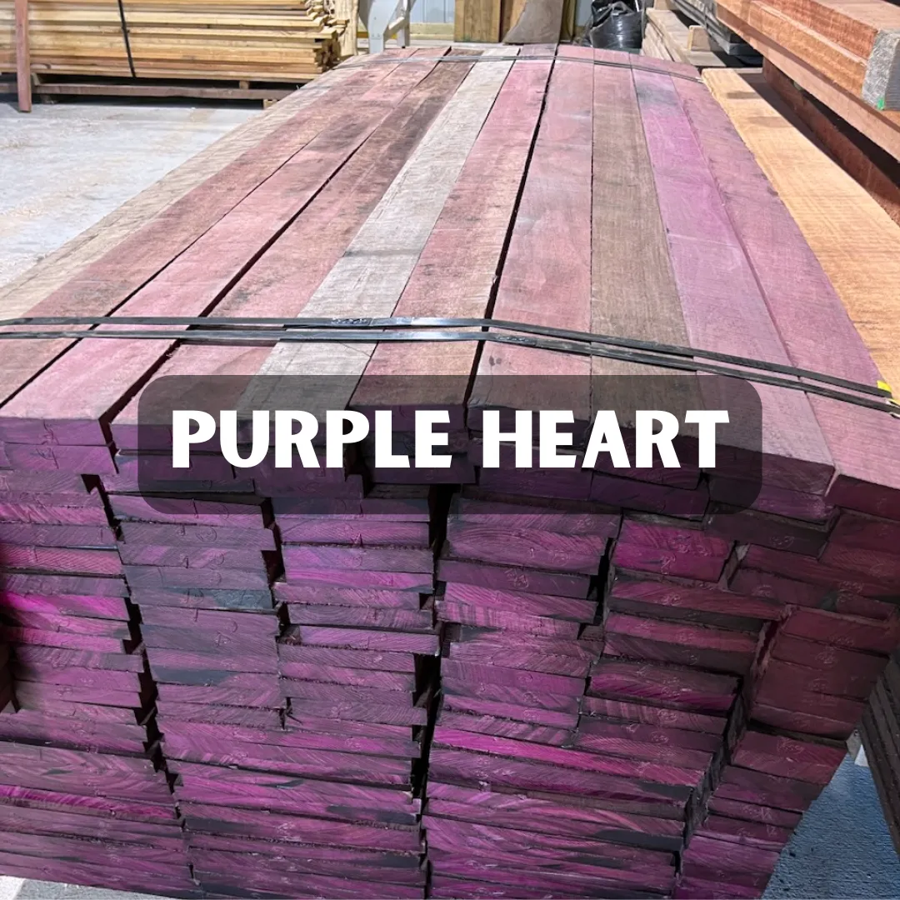
Purpleheart
Purpleheart is known for its distinctive purple coloration and high density.
It is frequently used for decorative accents, specialty furniture, inlays, and artistic woodworking. Its color can change over time, particularly with light exposure.
Padauk
Padauk is appreciated for its vivid orange-to-reddish tones.
It can provide strong visual contrast when combined with lighter wood species. Its natural color generally changes as the wood ages.
Sapele
Sapele is often selected for its reddish-brown appearance and attractive grain.
Certain boards display ribbon-like figure, making the species popular for decorative furniture and cabinetry. Interlocked grain may require careful machining to minimize tear-out.
Mahogany
Different wood species are sold under the name mahogany.
Their appearance, density, workability, and sourcing requirements may vary. Customers should confirm the actual species rather than assume all mahogany products have identical characteristics.
Teak
Teak is valued for the natural durability of suitable heartwood and its history of use in outdoor furniture and marine applications.
Its natural oils can influence gluing and finishing procedures. Proper sourcing, species identification, and construction practices remain important.
What Is the Best Wood for Furniture?
The best furniture wood depends on how the finished piece will be used.
| Furniture Project | Wood Species to Consider |
|---|---|
| Dining table | Walnut, white oak, hard maple |
| Coffee table | Walnut, cherry, oak, sapele |
| Desk | Walnut, maple, oak |
| Bookshelf | Oak, maple, suitable pine |
| Cabinetry | Maple, cherry, oak, walnut |
| Decorative furniture | Sapele, purpleheart, padauk |
| Outdoor furniture | Suitable teak, white oak, cedar, or other decay-resistant species |
These examples are starting points rather than universal recommendations.
The final choice should account for structural requirements, lumber quality, moisture content, budget, construction methods, and desired appearance.
Is Hardwood Better for Live Edge Tables?
Hardwood is a popular choice for live edge tables because many species offer attractive natural edges, distinctive grain patterns, and desirable furniture-making properties.
Popular options include:
- Black walnut
- White oak
- Maple
- Cherry
- Claro walnut
- Other suitable domestic and exotic species
However, softwood slabs can also be used for live edge furniture when their properties match the intended application.
The quality of the individual slab is particularly important.
Before purchasing a live edge slab, consider:
- Overall dimensions
- Usable width
- Thickness
- Moisture content
- Cracks and checks
- Natural defects
- Grain direction
- Flattening requirements
- Intended table base
- Finishing requirements
A beautiful slab that is insufficiently dried or structurally unsuitable may create problems after construction.
For additional information, read our previous article: What Is the Best Wood for a Live Edge Table?
Does Hardwood Warp Less Than Softwood?
Not necessarily.
Wood movement is influenced by moisture changes and the individual species’ dimensional characteristics.
Both hardwood and softwood can experience:
- Shrinkage
- Swelling
- Cupping
- Bowing
- Twisting
- Checking
The way lumber is sawn, dried, stored, and incorporated into a finished project influences its stability.
Quarter-sawn and flat-sawn boards may respond differently to moisture changes.
Woodworkers should also allow for seasonal wood movement when designing furniture.
Rigidly attaching a wide solid wood tabletop in a way that prevents normal movement can contribute to cracking or other problems.
Why Moisture Content Matters When Buying Lumber
Wood naturally exchanges moisture with the surrounding environment.
When humidity changes, wood may gain or lose moisture until it approaches equilibrium with its surroundings.
Northwest Florida’s humid climate makes appropriate lumber storage and moisture management particularly important.
Wood intended for indoor furniture should have a moisture condition suitable for its expected service environment.
Before beginning a project:
- Ask how the lumber was dried.
- Evaluate its current moisture condition.
- Store lumber appropriately.
- Allow for acclimation when necessary.
- Consider the environment where the finished piece will be used.
- Design joints and fasteners to accommodate wood movement.
Kiln-dried lumber can still absorb moisture after drying.
Similarly, air-dried lumber may require additional preparation before certain indoor applications.
The drying method alone does not guarantee that lumber is ready for every woodworking project.
Is Hardwood More Difficult to Work With?
Some hardwoods require more machining effort than commonly used softwoods.
Dense species may place greater demands on cutting tools and equipment.
Interlocked grain can increase the likelihood of tear-out, while certain wood species contain extractives that influence finishing or gluing.
However, many hardwoods are highly workable and popular among both beginners and experienced woodworkers.
Workability depends on:
- Density
- Grain direction
- Natural figure
- Moisture content
- Tool sharpness
- Cutting methods
- Species-specific properties
When working with unfamiliar exotic wood, test machining, adhesives, and finishes on a small offcut when possible.
Use appropriate dust extraction and respiratory protection.
Wood dust from both hardwood and softwood can create health hazards, and some species may cause additional irritation or allergic reactions.
Can You Mix Hardwood and Softwood in the Same Project?
Yes. Many woodworking projects combine different wood species.
For example, a furniture maker may use hardwood for visible surfaces and suitable softwood for concealed components.
Mixed-species projects can provide:
- Visual contrast
- Cost flexibility
- Different textures
- Reduced overall weight
- Decorative design opportunities
However, the materials should be selected according to their intended functions.
Differences in wood movement, density, finishing behavior, and mechanical properties should be considered during construction.
What Should You Look for When Buying Hardwood Lumber?
Selecting suitable lumber involves more than choosing an attractive species.
Inspect the Grain
Look for grain characteristics that complement your project and construction requirements.
Evaluate Natural Defects
Knots, checks, splits, and other features may be acceptable for decorative projects but unsuitable in certain structural locations.
Confirm Dimensions
Measure the actual thickness, width, and length. Nominal lumber dimensions may differ from finished dimensions.
Check Moisture Condition
Choose lumber appropriate for the expected environment of the finished project.
Consider Milling Requirements
Rough lumber and live edge slabs may require flattening, jointing, planing, or other preparation.
Calculate Usable Material
Account for waste, natural defects, trimming, and machining when determining how much lumber to purchase.
Confirm Availability
Specialty hardwood inventory can change. Contact your lumber supplier before making project plans that depend on a particular species, thickness, or slab size.
What Is a Board Foot?
Hardwood lumber is frequently sold by the board foot.
One board foot represents a volume of 144 cubic inches, equivalent to a piece measuring 12 inches long, 12 inches wide, and 1 inch thick.
The general calculation is:
Board feet = thickness in inches × width in inches × length in feet ÷ 12.
For example, a board measuring 2 inches thick, 8 inches wide, and 6 feet long contains 8 board feet.
Actual pricing and measurement conventions may vary for rough lumber, surfaced lumber, live edge slabs, and specialty pieces.
Ask your supplier how the specific material is measured and priced.
Where Can You Buy Hardwood Lumber Near Pensacola, Florida?
Finding the right hardwood supplier can make a significant difference when planning a woodworking project.
Peeples Exotic Wood is a family-owned business located in Cantonment, Florida, serving woodworking enthusiasts and customers in the Pensacola area. Learn more .
Since 2006, Peeples Exotic Wood has helped customers explore domestic and exotic wood options for a variety of woodworking applications.
Our product and service offerings include:
- Domestic hardwood lumber
- Exotic hardwood lumber
- Live edge wood slabs
- Woodturning stock
- Specialty woodworking materials
- Epoxy products
- Wood adhesives
- Slab flattening services
Whether you are planning a custom dining table, decorative woodworking project, furniture build, or woodturning project, selecting suitable material is an important first step.
Contact us to discuss your project and current inventory, or browse our and .
Address:
1516 Rouge Lane
Cantonment, FL 32533
Phone:
Website:
For more information, read our previous article: Where Can I Buy Exotic Hardwood Near Pensacola, FL?
Frequently Asked Questions About Hardwood and Softwood
What is the main difference between hardwood and softwood?
The main difference is botanical classification. Hardwoods come from angiosperms, while commercial softwoods primarily come from coniferous gymnosperms.
Is hardwood stronger than softwood?
Not always. Strength varies by species, grain orientation, moisture content, grade, and the type of mechanical load involved.
Is pine a hardwood or softwood?
Pine is classified as a softwood because it comes from a coniferous tree.
Is walnut a hardwood?
Yes. Walnut is a hardwood commonly used for furniture, cabinetry, live edge tables, and decorative woodworking.
Is oak harder than pine?
Many commonly used oak species are harder than many pine species. However, hardness should be compared using species-specific data.
Is bamboo a hardwood?
No. Bamboo is botanically a grass, although engineered bamboo products can have properties suitable for certain applications traditionally associated with hardwood.
Which wood is best for beginner woodworking?
Common pine species, poplar, and other relatively workable materials may be suitable for beginners. The best choice depends on the project, tools, budget, and desired finish.
Is hardwood better for outdoor furniture?
Not necessarily. Outdoor performance depends on natural decay resistance, moisture exposure, construction methods, and maintenance.
What is the difference between domestic and exotic hardwood?
Domestic hardwood generally refers to species grown within the relevant home market, while exotic hardwood commonly refers to imported or less locally familiar species. These terms do not establish quality or performance.
Does hardwood need to be kiln dried?
Not every hardwood application requires kiln drying. The important consideration is whether the lumber’s moisture condition is suitable for its intended use.
Can I use softwood for a dining table?
Yes. Suitable softwood can be used for dining tables, although some species may dent more easily than denser hardwoods.
Where can I buy exotic hardwood near Pensacola?
Peeples Exotic Wood in Cantonment, Florida, offers domestic and exotic lumber, live edge slabs, and specialty woodworking materials. Contact us to discuss current availability.
Find the Right Wood for Your Next Project
Understanding the difference between hardwood and softwood can help you make better decisions when purchasing lumber.
Rather than choosing a material based solely on its classification, consider the specific species, appearance, moisture condition, workability, durability, and project requirements.
Whether you are an experienced furniture maker or starting your first woodworking project, Peeples Exotic Wood can help you explore suitable materials.
Visit us in Cantonment, Florida, or contact us to discuss your next project.
Location
1516 Rouge Lane, Cantonment, FL 32533
Hours
Tue, Wed, Fri 10 AM–4 PM · Sat 7 AM–3 PM
Sources & Further Reading
- USDA Forest Service, Forest Products Laboratory. Wood Handbook: Wood as an Engineering Material.
Technical reference covering wood anatomy, mechanical properties, moisture relationships, dimensional stability, natural durability, and woodworking characteristics.
- The Wood Database.
Species-specific information concerning wood identification, Janka hardness, density, appearance, workability, and common applications.
- Oregon State University Extension. Wood and Moisture Relationships.
Educational guidance concerning wood moisture content, humidity, shrinkage, swelling, and dimensional changes.
- University of Missouri Extension. Wood Identification and Properties.
Educational information concerning wood characteristics and species identification.
- Occupational Safety and Health Administration. Wood Dust.
Information concerning occupational wood dust exposure and related health hazards.
- Peeples Exotic Wood. Official Website.
Business information, lumber products, woodworking materials, and contact details.
References are provided for educational purposes and do not imply that the USDA, Oregon State University Extension, the University of Missouri Extension, the Occupational Safety and Health Administration, The Wood Database, or any other referenced organization endorses Peeples Exotic Wood or any particular product.